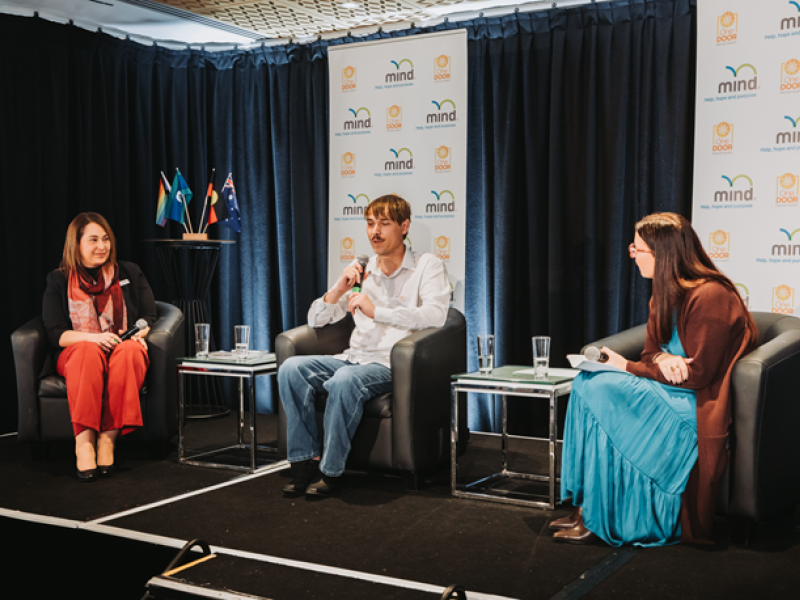
Community-managed Step Up Step Down (SUSD) services should play a greater role in New South Wales' mental health system, according to researchers, practitioners and people with lived experience who spoke at the 2026 One Door Mental Health Symposium.
The Symposium showcased the growing evidence that community-managed SUSD services improve recovery outcomes, reduce the need for future inpatient admissions, and provide a welcoming, recovery-focused alternative to hospital care.
What is a Step Up Step Down service?
Step Up Step Down services provide short-term residential support for people experiencing mental health challenges who need more intensive support than community-based care alone, but who do not require acute hospital treatment.
Presented by Dr Laura Hayes from Mind Australia's Research and Evaluation team, the session explored how these services bridge an important gap in the mental health system while placing people, choice and recovery at the centre of care.
Dr Hayes also outlined the growing body of evidence demonstrating positive outcomes for people accessing community-managed SUSD services.
“SUSD offers a step down from inpatient care or a step up from community-based support when more intensive care is needed,” Dr Hayes said.
“It’s got a very strong recovery orientation and provides 24-hour support in a lovely home-like environment.”
Dr Hayes also presented evidence from outcome measures collected from Mind SUSD services in Victoria (known as Prevention and Recovery Care services), Queensland and Western Australia, as well as published literature, showing sustained improvements in recovery, quality of life, psychological distress, mental health and wellbeing, self-efficacy, and social engagement for people who access SUSD services. These outcomes are maintained for up to 12 months after a stay, reducing the likelihood of future inpatient stays.
People who access SUSD services consistently report positive experiences, highlighting the welcoming environment, fewer restrictions, and access to practitioners who take the time to listen and engage in meaningful conversations.
Why does New South Wales need more community-managed services?
Mental Health Coordinating Council CEO Dr Evelynne Tadros said community-managed services have an important role to play in strengthening the New South Wales mental health system.
While clinical services remain essential, Dr Tadros said community-managed organisations offer a complementary approach that places recovery, relationships, choice, and connection at the centre of care.
Dr Tadros has been a long-time advocate for increased investment in SUSD services across New South Wales, describing them as a vital part of a balanced mental health system.
“When you see the satisfaction rates from SUSD consumers are over 90%, why would you not want to invest in that model?” Dr Tadros said. “People with lived experience are seeing the value of those programs and are benefiting holistically.”
The discussion highlighted that expanding community-managed sub-acute services could provide more timely access to support while easing pressure on hospital emergency departments and inpatient services.
Recovery looks different when lived experience is at the centre
Mind Peer Worker Liam Annetts shared his experience of accessing an SUSD service, describing how it differed from previous experiences with the mental health system.
Rather than feeling defined by his symptoms, Liam spoke about the impact of being supported by peer workers who understood recovery through their own lived experience and helped create an environment built on hope, connection, and mutual understanding.
“I was 17 when I first accessed the service,” Liam said. “I previously had multiple inpatient involuntary stays. When I first interacted with a SUSD peer worker and he asked me if I wanted to play Xbox with him… I’d never had that experience. Him sharing his experiences made me comfortable to share my experiences.”
Liam said the support he received from peer workers inspired him to become a peer worker himself.
“There’s a lot that makes SUSD great,” Liam said. “The importance of peer work is just a person-centred practice and the recovery focus. We build a lot of connections where you feel comfortable enough to be able to speak about certain topics.”
Liam's reflections reinforced the important role peer work plays in recovery-oriented mental health care.
Community-managed care delivers more than clinical support
Each panellist brought a different perspective, but a common theme was that recovery extends beyond treating symptoms.
Through research, policy, and lived experience, the panel highlighted the importance of services that help people reconnect with community, strengthen relationships, build confidence, and regain a sense of purpose.
When discussing the effectiveness of community-managed models, Liam said their focus extends beyond immediate support to helping people build the skills and confidence they need for life beyond the service.
“It’s always future-focused, which I think is great,” he said.
As New South Wales considers the future of its mental health system, the discussion highlighted the important role community-managed SUSD services can play in delivering holistic recovery-focused support that complements clinical care and helps people stay connected to their communities.
Watch the full Symposium recording for more insights and discussions.