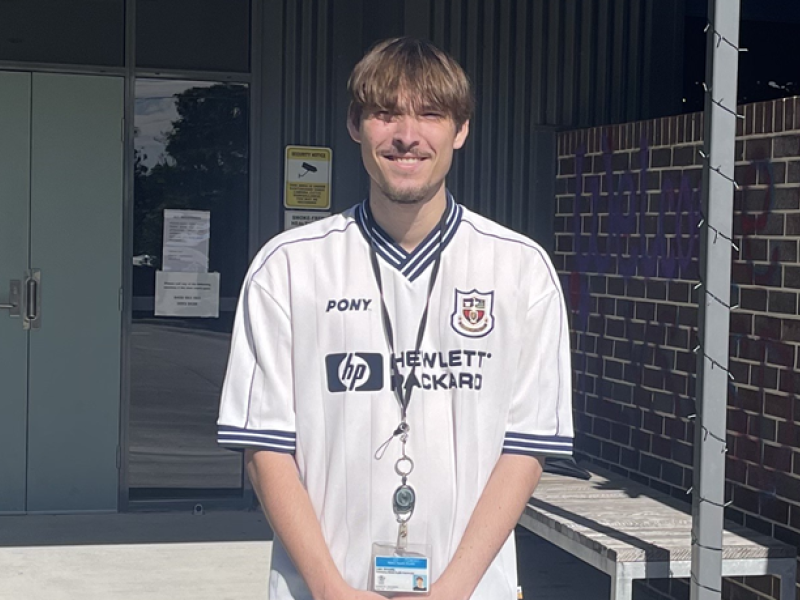
Liam Annetts used Mind Australia’s support services and later became a Peer Practitioner himself. It has given him a unique perspective on the role peer support plays in helping people experiencing mental health challenges.
Presenting at this year’s TheMHS Learning Network Conference in Brisbane, Liam (22) shared his journey from service user to employee at the Youth Step Up Step Down in Logan (Queensland).
Liam was 17 when he went to the Step Up Step Down service following a period of distress. Inspired by his experience, he made it his mission to give others the same hope and support that had helped him turn his own life around. He decided to become a peer practitioner – someone who draws on their own lived experience of mental health challenges to provide practical and emotional support to others who are struggling. After completing a Certificate IV in Mental Health Peer Work, he joined Mind’s Lived Experience workforce.
Liam said people often feel underwhelmed and unsupported in mental health services. In his experience, the involvement of peer practitioners strengthens people’s engagement with the program they are accessing and leads to more positive outcomes.
“Throughout my experience being a service user, I was involved in many different services from the likes of psychology, psychiatry, alcohol and other drug support, and Dialectical Behaviour Therapy (DBT) groups. Step Up Step Down was the first service that introduced me to peer workers, and to say they helped is an understatement,” Liam said.
“I went from feeling disconnected from mental health workers – experiencing invisible barriers and power dynamics that made me want to disengage - to being supported by lived experience workers who shared their similar insights and were a living, breathing demonstration of possible recovery. It was a powerful change.”
The Logan Youth Step Up Step Down, which is delivered in partnership between Mind and Queensland Health, embraces and harnesses the power of peer practitioners to create a warm, welcoming and recovery-focused environment.
“For young people, having access to peer practitioners helps to create a positive initial relationship, which can help build trust within the service to further engage with the program and other staff,” Liam said.
Giving back to community and supporting young people in distress has been deeply rewarding and it’s a job that he loves dearly, but Liam says the peer practitioner role has its fair share of challenges.
A common challenge faced by lived experience staff throughout the sector is the emotionally demanding nature of the work. Peer practitioners are continuously engaging in distressing conversations that involve their own personal experience, as well as the lived experience of others.
“You tie this in with other mental health professionals in the sector undermining the effectiveness and validity of peer work and questioning the value of lived experience, and it can be a challenging space to operate in,” Liam said.
“I’ve also experienced the families of service users questioning my suitability to even be working - or in their words, if I have actually ‘recovered’.”
Other challenges faced by lived experience workers outlined in Liam’s presentation include:
- limited training opportunities and career pathways
- service models that don’t embrace recovery-oriented support and instead prioritise medical or risk-averse approaches
- services where supervisors are unequipped to support peer work.
“When the team works together and utilises every perspective, that’s when the service truly benefits,” Liam said. “Peer workers aren’t an extra piece in the puzzle; they’re part of the picture that makes the puzzle whole, and when you leave one piece out, the whole puzzle changes.”