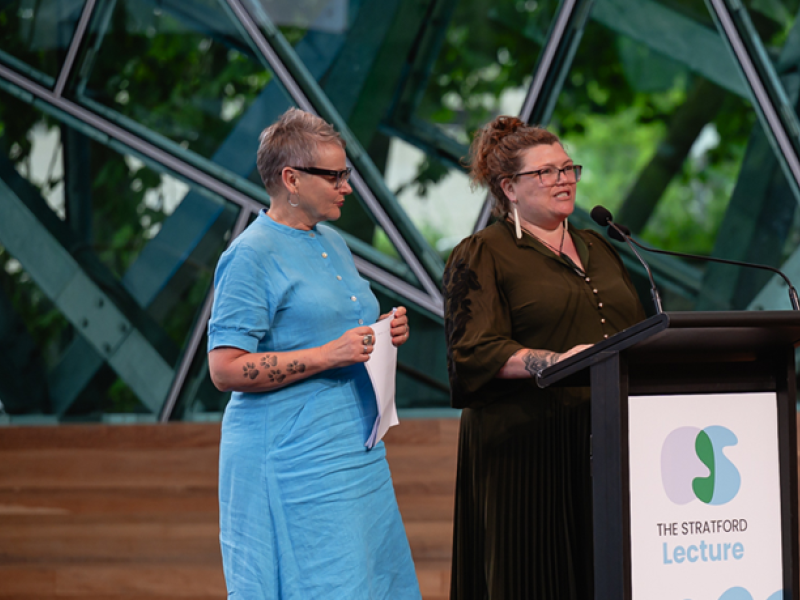
In this excerpt from the 2026 Stratford Lecture, co-guest speaker Rana Te Huia shares a powerful story from her own professional experience in Aotearoa New Zealand that demonstrates the failure of a model of lived experience without lived experience governance power. She and her co-speaker Magdel Hammond then reflected on and invited discussion on this failure.
The story
A peer support organisation I worked with was given the opportunity to staff and run a section of an acute inpatient unit known as ‘Day Services’. It was a large, light-filled space with an outdoor area, kitchen, lounges, and art spaces, staffed by two to three peers.
Although it sat within the inpatient unit - requiring ongoing negotiation about how we worked - it became a place where people could relax. There were no cameras, no assessments, no constant monitoring. People could focus on what they enjoyed rather than being defined by what was “wrong” with them. It was a space for conversation, creativity, friendship, strength, and hope - not just patient identity.
One wahine (woman) staying at the unit, who had experienced years of abuse and racism in the mental health system, spent most of her time in our Peer Space. She felt safer there, surrounded by peers.
One day, while we were in the space, a managing nurse told us we had to clear out because she had refused medication and they planned to restrain her and administer an injection. We protested, explaining this would destroy the trust built in the space and went against our peer framework and model of care. The decision was escalated to management.
The nurses came in, restrained her, and injected her. This action eroded the trust we had built, not only with her, but with others staying on the unit. It damaged the sense of safety in the space and, for a long time, undermined the authenticity and credibility of the lived experience workforce within the hospital setting.
I think about this often and know for certain that if we really had a voice at that higher leadership level this would have never happened.
The discussion
We share a deep belief that lived experience leadership is not a niche or a “nice to have,” but a transformative force.
If lived experience workers deliver services but are not equal all the way up to - and including - governance, power does not truly shift. An organisation may look progressive by employing peer workers and using recovery language, but key decisions about funding, priorities, risk, and acceptable practice still sit with traditional leadership. The system changes its appearance, not its foundation.
Without governance authority, lived experience roles can become limited to carrying out decisions made by others. Workers may be expected to build trust and offer hope while operating within policies (often clinical policies) they did not design - often policies that prioritise risk control over dignity and reinforce clinical hierarchies. The language may change, but decision-making remains the same. This destroys the entire peer practice.
We see it everywhere — in boardrooms, service design, and in projects that call themselves co production or co design but won’t release any meaningful decision making. And if we aren’t careful, the way mainstream systems use Lived Experience leadership will continue to be tamed, softened, domesticated - silenced.
Leadership isn’t a symbol. It’s something you earn — in practice, in accountability, in whakapapa (line of descent) - not just something nominally bestowed because a system wants to look progressive.
Systems struggle to hold the heat and truth of what we (Lived Experience leaders) bring. When tension shows up, many default back to old rules and old hierarchies — and Lived Experience governance gets quietly pushed aside.
Another fire we face is this: people with lived experience being pushed into leadership roles without development, without mentoring, without any real preparation. And when the structure fails them, they’re the ones who carry the blame. The judgement is sharp, and the support is thin.
And still, so many organisations don’t know how to support a lived experience workforce or how to hold lived experience governance with integrity. Some fear the changes required if true lived experience leadership actually prevails.